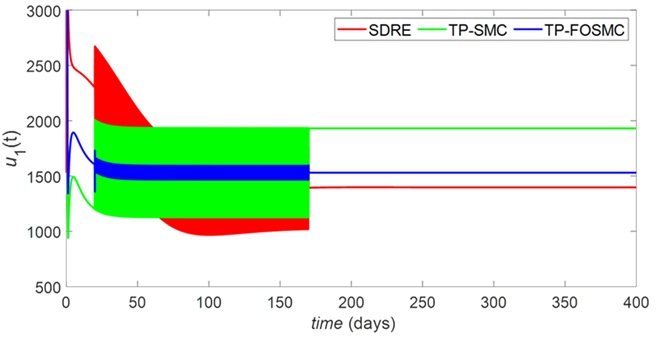
Sugarcane is a key economic crop in subtropical and tropical regions, serving as a major raw material for the food and biofuel industries. However, its cultivation is severely affected by the sugarcane borer, a destructive pest. To mitigate this issue, biological control strategies—using natural enemies to regulate pest populations—offer an environmentally friendly alternative to chemical pesticides. This study proposes a tensor product–based fractional-order sliding mode control (TP-FOSMC) approach to formulate an effective biological control policy for a nonlinear pest–parasitoid agroecosystem. The controller design utilizes tensor product model transformation (TPMT) to facilitate the synthesis of the fractional-order sliding mode controller, which enhances system robustness and significantly reduces chattering in the control inputs. System stability is verified using the Lyapunov stability theorem. Numerical simulations under bounded disturbances demonstrate that the proposed TP-FOSMC effectively regulates both pest and parasitoid populations to their desired levels. Compared with the state-dependent Riccati equation (SDRE) and tensor product–based conventional sliding mode control (TP-SMC) strategies, the proposed method achieves faster convergence and substantial chattering reduction, confirming its robustness and practical feasibility for sustainable pest management.